
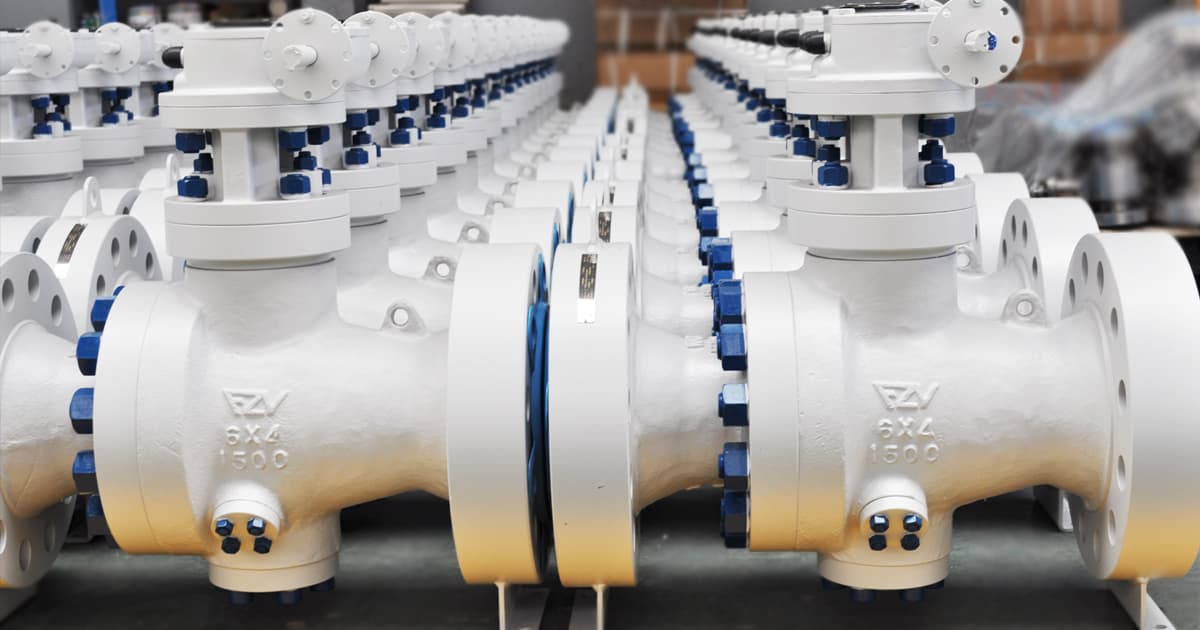
Top Entry Ball Valves
Engineered for general service and heavy-duty applications, with a focus on inline repairability.
Size Range
2" – 56"
Class Range
150 – 2500
Temperature Range
-320°F to +700°F (-196°C to +371°C)
Reference
Design Standard
- API 6D
- API 608
- ISO 17292
Face to Face
- ASME B16.10
Flange
- RF/RTJ: ASME B16.5
- Over 24": ASME B16.47 / MSS SP-44
- Butt weld: ASME B16.25
Marking
- MSS SP-25
Inspection
- API 598
Pressure & Temp.
- ASME B16.34
Quality
- API Q1
- MSS SP-55
Fire Safe Design
- API 607
Sour
- NACE MR0175
- ISO 15156
Top Flange
- ISO 5211
Pressure Testing
- API 6D, CSA Z245.15 — includes both high and low pressure air seat test
Documentation
- BS EN 10204-3.1
Design Features
- —Accessible top-entry design: bonnet, ball, seat, and stem can be removed and installed in-line for repair without removing the valve from the line
- —Locking device prevents valve misoperation
- —Stem-flyout prevention design guards against abnormal cavity pressurization
- —Fireproof and antistatic design
- —DBB, DIB-1, and DIB-2 seat options available
- —All sizes double block and bleed capable per API 6D
- —Buried check valve beneath the injection fittings allows fitting replacement without re-hydrotesting the body
Materials Available
Casting Material
- WCB
- LCB
- WC6
- WC9
- C5
- C12
- CF3
- CF3M
- CF8
- CF8M
- C95500
- 4A
- 5A
- Inconel 825/625
Forging Material
- A105
- LF2
- F11
- F12
- F304
- F321
- F347
- F316
- 304L
- 316L
- C61900
- F51
- F53
- F55
- Inconel
Literature
Select what you'd like below and we'll email you secure download links.
Catalogue
Snapshot & One-Pager
Unique to Ranger
High-Pressure Pneumatic Shell Test
For all cast steel gate, globe, and check valves, as well as cast trunnion and floating ball valves, RANGER-FZV submerges the completed, uncoated valve in water and pressure tests the casting with nitrogen or compressed air. Pinholes or casting deficits invisible to a standard hydrotest are revealed as bubbles in the water — castings have failed this test after passing hydrotest.
View full Casting Quality program →